Which Cosmetic Ingredients Prevent Moisture Loss? A Developer's Reference
The Business Case for Mechanism-Level Hydration Data in Skincare Apps
Your POST /v1/analyze returns a 47-ingredient INCI list. The product page needs to render a "Helps prevent moisture loss?" badge in the next 200ms. Without functional classification, you have two bad options: flag everything containing water-related terms (false positives that destroy credibility with informed users), or hardcode an allow-list that breaks the moment a brand swaps "shea butter" for "Butyrospermum Parkii Butter."
The question which cosmetic ingredient helps to prevent moisture loss has no single answer. It has three answers, mapped to three mechanisms, and your API response needs to expose all three. A mechanism-based classification system, the twelve ingredients that matter, an API workflow for detecting structural gaps in formulations, and the regulatory line you cannot cross — that is what the next 4,000 words deliver.
Table of Contents
- The Business Case for Mechanism-Level Hydration Data
- Three Mechanisms, Mapped to API Fields
- The Twelve Ingredients That Actually Move TEWL
- A Reproducible Workflow for Detecting Moisture-Prevention Gaps
- Shipping Hydration Features Without Inventing Claims
- Edge Cases and Honest Limits
- Implementation FAQ
The global facial care market was valued at $94.2 billion in 2022 and is projected to reach $136.7 billion by 2032 at a CAGR of 3.8%, with hydration and moisturizing as dominant positioning themes, according to Allied Market Research. That market size is why every skincare app, e-commerce product page, and DTC brand needs defensible hydration logic. The category is large enough that vague claims invite regulatory scrutiny, dermatologist criticism, and consumer backlash.
The question which cosmetic ingredient helps to prevent moisture loss is the one your users are implicitly asking every time they scan an INCI list. If your app answers it badly, three failure modes follow.
Over-labeling. Flagging any product with water in the INCI as "hydrating." Dermatologist users and informed consumers stop trusting the app within a session.
Under-labeling. Only flagging hyaluronic acid and glycerin. Products containing petrolatum or ceramides — the two ingredients dermatologists rank highest for dry skin — appear as "non-hydrating."
Single-mechanism labeling. Calling humectants "hydrating" without acknowledging they fail without occlusion in dry climates. Per Verdier-Sévrain and Bonté in J Cosmet Dermatol 2007: "At low relative humidity, humectants may actually enhance water loss from the skin if used alone." An app that recommends a hyaluronic acid serum to a user in Phoenix in February is shipping a known bug.
The only defensible classification is the three-mechanism framework — humectant, occlusive, emollient — established in Loden's Am J Clin Dermatol 2003 review on emollients and moisturizers in dry skin barrier disorders. Each mechanism has a different physical action, a different climate sensitivity, and a different role in any defensible "prevents moisture loss" claim.
The measurable outcome behind all of this is transepidermal water loss (TEWL), expressed in g/m²/h, with normal facial skin baseline at 5–15 g/m²/h measured via Tewameter or AquaFlux per the EEMCO guidance (Rogiers 2001). TEWL is the metric the science actually measures. "Hydration" is the marketing word. TEWL is the engineering word, and your data model should be built around it.
Then there is the regulatory boundary. Under the EU Common Criteria for Cosmetic Claims (Regulation (EU) No 655/2013), claims like "moisturizing" or "reduces TEWL" must be truthful and supported by evidence. No pre-approval exists. Responsibility sits with whoever publishes the claim — and that includes your app. On the US side, the FDA distinguishes cosmetic claims ("moisturize, soften") from drug claims ("treat eczema, repair barrier dysfunction"). An app that says "this product repairs your skin barrier" has implicitly made a drug claim on behalf of a non-drug product.
API-backed classification is cheaper than litigation and cheaper than rebuilding a static allow-list every quarter. An ingredient database like Dermalytics returns functional category, severity label, irritancy score, and comedogenicity score per ingredient — exactly the inputs your hydration logic needs to produce a verdict that survives scrutiny.
Humectants, Occlusives, Emollients — The Three Mechanisms, Mapped to API Fields
Every ingredient that contributes to preventing moisture loss does so via one of three mechanisms. Get this taxonomy right and the rest of the article — and your code — snaps into place. Get it wrong and you ship a classifier that mislabels half the products in any cosmetics catalog.
| Mechanism | How It Works | Representative Ingredients | TEWL Impact | Climate Sensitivity |
|---|---|---|---|---|
| Humectant | Hygroscopic; pulls water into stratum corneum | Glycerin, hyaluronic acid, urea, propylene glycol | 10–20% glycerin reduces TEWL vs. vehicle (Fluhr 2008) | Fails in low humidity without occlusion |
| Occlusive | Forms hydrophobic film blocking water egress | Petrolatum, dimethicone, lanolin, mineral oil | Petrolatum reduces TEWL ~50–75% (Loden 2003) | Climate-independent |
| Emollient | Fills inter-corneocyte gaps; improves flexibility | Squalane, cetyl alcohol, shea butter, triglycerides | Modest direct TEWL effect (Loden 2003) | Mostly climate-independent |
The table answers the question honestly: there is no single ingredient that prevents moisture loss. There are three categories that work together. As Draelos puts it in Cosmetic Dermatology: Products and Procedures (2nd ed., 2015): "Humectants such as glycerin attract water into the stratum corneum, but without an appropriate occlusive agent, that water can simply evaporate. An effective moisturizer combines humectants, emollients, and occlusives to optimize barrier function."
Walk through the first failure case. A serum with only sodium hyaluronate applied in Phoenix in February (RH ~20%) can increase net TEWL because the humectant pulls water from the dermis, which then evaporates from the skin surface unimpeded. The user gets a tighter, drier face and a bad review for the brand — and for your app, if it told them this product was hydrating.
The inverse failure: pure petrolatum keeps water in but does not add any. Applied to already-dehydrated skin, it locks in dehydration. The mechanisms are complementary, not interchangeable.
The API integration point is straightforward. A POST /v1/analyze call returns per-ingredient data including functional category, irritancy, comedogenicity, and severity. Your job is to count matches in each functional category and surface gaps. Three humectants plus zero occlusives does not equal a hydrating product. It equals a humectant-only formulation that depends on whatever the user layers next.
Returned fields you will use repeatedly: the functional category drives your mechanism count, the comedogenicity score (0–5) lets you demote heavy occlusives for acne-prone profiles, and the irritancy score (0–5) lets you flag synergy killers like denatured alcohol. The rest of this article assumes those three fields are wired into your service.
The Twelve Ingredients That Actually Move TEWL — Identification Reference
The universe of "hydrating ingredients" marketed by brands runs to the hundreds. The universe that has clinical evidence behind it and appears reliably in formulations is much smaller. These twelve cover the majority of mass-market and prestige products you will encounter in any catalog.

Humectants
1. Glycerin. Synonyms: glycerol, glycerine. Mechanism: humectant. Typical range 2–20%, with therapeutic moisturizers using ≥10% per Draelos Cosmetic Dermatology (2015). Clinical trials show 10–20% glycerin creams significantly improve stratum corneum hydration and reduce TEWL versus vehicle in dry skin and atopic dermatitis patients, per Fluhr et al., Br J Dermatol 2008. API returns a match with low irritancy.
2. Hyaluronic Acid. Synonyms: sodium hyaluronate, hyaluronan. Mechanism: humectant. Binds up to 1,000× its weight in water depending on molecular weight, per Pavicic et al., J Drugs Dermatol 2011. The caveat is significant: high-MW HA forms a surface film, low-MW HA penetrates, and efficacy is formulation-dependent per Papakonstantinou et al., Dermatoendocrinol 2012. API returns a match; molecular weight is supplier metadata and not in API scope.
3. Urea. Mechanism: humectant (keratolytic at higher concentrations). Range 2–10% in cosmetic moisturizers, up to 40% in keratolytic products (Draelos 2015). Ranked among the top five dermatologist-recommended ingredients for dry skin in the Northwestern Medicine survey summary of Poon et al.
4. Propylene Glycol. Mechanism: humectant and solvent. Range 2–15% (Draelos 2015). Underperforms glycerin and urea at equivalent concentrations in corneometry studies (Fluhr 2008). Useful as a co-humectant; rarely the lead.
Occlusives
5. Petrolatum. Synonyms: petroleum jelly, white petrolatum. Mechanism: occlusive. Range 5–20% in creams and lotions, up to 100% in ointments, per Barel et al., Handbook of Cosmetic Science and Technology (4th ed.). Reduces TEWL ~50–75% per Loden 2003, with up to 98% reduction in some in-vitro models per Draelos, J Am Acad Dermatol 2012. Dermatologists rank it the #1 recommendation for dry skin at 85.5% (Poon, Northwestern Medicine). As Murase notes in the same JAAD paper: "White petrolatum remains one of the most effective and economical occlusive moisturizers available. It can reduce transepidermal water loss by more than half, but patients often underuse it due to its greasy feel."
6. Dimethicone. Mechanism: silicone occlusive. Range 0.5–2% (Barel 2014). Non-comedogenic, cosmetically elegant — the standard alternative to petrolatum when product feel matters.
7. Lanolin. Mechanism: partial occlusive. Less occlusive than petrolatum, more than mineral oil per Draelos, Cosmetics and Dermatologic Problems and Solutions (3rd ed.). Worth surfacing the irritancy score from the API — lanolin is a known allergen for a non-trivial slice of users.
8. Mineral Oil. Mechanism: partial occlusive. Less effective than petrolatum at TEWL reduction. Common in budget formulations and baby oils; functional but not best-in-class.
Barrier Lipids and Emollients
9. Ceramides. Mechanism: physiologic barrier lipid (technically a barrier-repair emollient). Ranked #2 for dry skin (82.1%) by dermatologists (Poon, Northwestern). Most effective at the 3:1:1 ceramide:cholesterol:fatty acid ratio per Rawlings and Harding, Dermatol Ther 2004. Long-term barrier restoration outperforms petrolatum-only occlusion in atopic skin per Chamlin et al., J Am Acad Dermatol 2002. Linda Stein Gold, in Dermatology Times, notes: "Ceramides help replenish the skin's natural lipids and are especially helpful in conditions of impaired barrier, such as atopic dermatitis. They work best as part of a multi-lipid system with cholesterol and fatty acids."
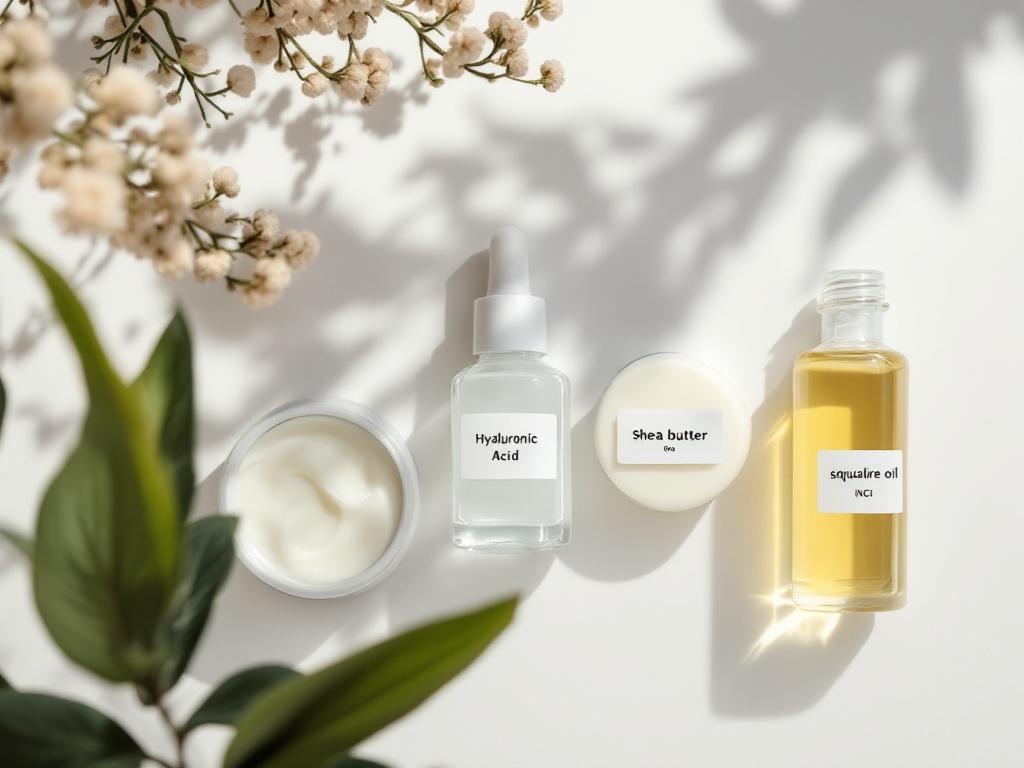
10. Squalane. Mechanism: emollient. Lightweight, low comedogenicity, low irritancy — the workhorse "feel-good" emollient in modern serums and lightweight creams.
11. Butyrospermum Parkii Butter (Shea Butter). Mechanism: emollient with partial occlusive properties. Plant lipid, popular in body care and rich facial creams.
12. Cetyl Alcohol. Mechanism: emollient and structuring fatty alcohol. Range 1–10% (Barel 2014). Despite the name, it is not drying — fatty alcohols are not the same chemical class as denatured alcohol.
Treat this list as the minimum coverage for any hydration-detection feature. If your classifier misses any of these twelve, you have a known gap that an informed user will find within a week of launch.
A Reproducible Workflow for Detecting Moisture-Prevention Gaps via API
This is the workflow a backend service or scanner app runs against any formulation to produce a defensible verdict on whether the product prevents moisture loss. It assumes ingredient data from an indexed cosmetic ingredient API; the logic is portable to any provider that exposes functional category, irritancy, and comedogenicity fields.
Step 1 — Submit the formulation
POST https://api.dermalytics.dev/v1/analyze
{
  "ingredients": [
    "Aqua", "Glycerin", "Sodium Hyaluronate",
    "Cetyl Alcohol", "Dimethicone", "Phenoxyethanol",
    "Alcohol Denat"
  ]
}
Credit-based pricing means only successful matches bill against your quota. Unmatched ingredients return in a separate field for the developer to handle — do not silently drop them.
Step 2 — Classify each matched ingredient
Map each match to humectant, occlusive, or emollient using the response's functional category field. Build a counter object:
{
  humectants: 2,   // Glycerin, Sodium Hyaluronate
  occlusives: 1,   // Dimethicone
  emollients: 1,   // Cetyl Alcohol
  unmatched: 1     // Phenoxyethanol is a preservative, not a moisture agent
}
Aqua and Alcohol Denat are not moisture-prevention ingredients and should not enter the counter. They are handled separately in Step 5.
Step 3 — Detect the structural gap
Apply the rule from the previous section. If humectants > 0 && occlusives === 0, flag the formulation as "humectant-only — moisture loss likely in low-humidity conditions." Cite the humidity dependence in user-facing copy when surfacing to dermatologist-grade users, referencing Verdier-Sévrain 2007.
The inverse rule is equally important: occlusives > 0 && humectants === 0 should produce "Seals only — pair with a humectant serum or apply to damp skin." Pure occlusion without water to seal in is functionally a barrier, not a moisturizer.
Step 4 — Apply skin-type filters
Use the irritancy and comedogenicity scores (0–5) to demote ingredients that conflict with the user's profile.
- Acne-prone profile: demote occlusives with comedogenicity ≥3. Lanolin and some plant butters fall here; dimethicone and petrolatum do not.
- Sensitive skin profile: demote ingredients with irritancy ≥3. Denatured alcohol, some essential oils, and certain preservatives are common offenders.
The filter does not change the mechanism count — it changes the verdict copy ("contains an occlusive that may aggravate acne-prone skin").
Step 5 — Detect synergy killers
Flag formulations where high concentrations of denatured alcohol or astringents appear above humectants in the INCI list. INCI order is descending by weight above 1%, so an ingredient listed before glycerin is present at a higher percentage. The API does not return percentage concentration — INCI position is a heuristic, not a measurement, and you should label it as such in the UI.
Step 6 — Render the user-facing verdict
Three possible outputs:
- Hydrates and seals — at least one humectant and one occlusive, no synergy killers, irritancy and comedogenicity acceptable for the profile.
- Hydrates only — layer with an occlusive — humectants present, occlusives absent.
- Seals only — pair with a humectant serum — occlusives present, humectants absent.
A POST /v1/analyze response is deterministic for a given INCI list, which means you can cache by hash of the sorted ingredient array. Median latency runs sub-100ms, and a 50-ingredient formulation typically returns in 50–80ms under the 99.9% uptime SLA. For most apps, caching makes the per-request economics negligible.

A formulation with three humectants and zero occlusives is not a hydrating product. It is a humectant product that depends on whatever the user applies next — and your app should say so.
Shipping Hydration Features Without Inventing Claims You Can't Defend
The workflow above tells you what to compute. This section tells you what to ship and what to label, and where the line sits between defensible product copy and a regulatory invitation.
Ingredient scanner features. Mobile apps that let users photograph an INCI list and return a verdict. The honest output is mechanism counts: "3 humectants, 1 occlusive, 2 emollients detected" with a one-line explanation. Your scoring weights should reflect that dermatologists rank petrolatum (85.5%) and ceramides (82.1%) above hyaluronic acid (79%) and urea (79%) for dry skin (Poon, Northwestern). A scanner that ranks a hyaluronic acid serum above a ceramide cream for a dry-skin user has its weights inverted relative to clinical practice.
E-commerce product pages. A "Hydration profile" widget showing mechanism breakdown is more defensible — and SEO-friendlier — than a "Hydrating ✓" badge. Surfacing the ingredients responsible ("Glycerin and Petrolatum power the hydration in this formula") creates structured, citation-grade copy that search engines index as informational rather than promotional. The widget renders the same way for a $12 drugstore moisturizer and a $90 prestige cream, which is exactly the comparison your users want to make.
Routine builders. If a user inputs "dehydrated skin in winter (low RH)," the engine should require at least one occlusive in the routine. Humectants alone in low humidity can worsen TEWL — a recommendation engine that ignores climate ships a known bug. Pull relative humidity from a weather API keyed to the user's location, or ask once at onboarding, and trigger the occlusive requirement when RH falls below the threshold.
Comparison features. Because INCI names normalize across brands, side-by-side mechanism counts let users compare formulations on actual function rather than marketing language. Brand A's "Shea Butter" and Brand B's "Butyrospermum Parkii Butter" resolve to the same canonical ingredient. This is the differentiator versus consumer-facing reference sites: programmatic access plus regulatory metadata lets you build features they cannot.
The API tells you what is in the formula and how each ingredient functions. It does not tell you whether the formula is right for this user, in this climate, in this routine — that is where your product strategy lives.
Claim substantiation surface. EU Regulation 655/2013 requires evidence behind "moisturizing" or "reduces TEWL" claims. If you operate in the EU or sell to EU brands, an API-backed widget that says "Contains 2 clinically-studied humectants (glycerin, hyaluronic acid)" is safer than a brand-written "deeply hydrates for 24 hours" — because the former is verifiable against ingredient data, while the latter requires a clinical study the brand may not have on file.
FDA-side caution. The cosmetic-versus-drug line in the US is sharp. If your app surfaces "this formula repairs your skin barrier," you have implicitly made a drug claim on behalf of a product that is not regulated as a drug. The safer copy is mechanism-descriptive: "Contains ceramides, which are part of the skin's natural barrier lipids." That sentence is true, sourced, and does not promise a therapeutic outcome.
The lipid-ratio nuance. For premium apps targeting eczema-adjacent users, surface the ceramide-to-cholesterol-to-fatty-acid ratio when the formulation discloses enough information to estimate it. The 3:1:1 ratio is the published target for physiologic-lipid barrier repair (Rawlings and Harding 2004). The API returns ingredient presence; ratio inference is a derived feature your team builds on top, and it is a credible reason for a paying tier in a freemium app.
Edge Cases and Honest Limits of Ingredient-Level Hydration Data
Every developer building hydration features will hit these edge cases. Anticipate them in your data layer; do not pretend they do not exist in the UI.
- Hyaluronic acid is not a single ingredient. High molecular weight HA forms a surface film; low-MW HA penetrates but is often at trace concentrations. The theoretical "1,000× water-binding" figure does not predict in vivo hydration on its own. Surface the limitation honestly: "HA molecular weight not disclosed by brand; efficacy depends on formulation context."
- Concentration is invisible to ingredient APIs. INCI order is the only signal — descending by weight above 1%, any order below 1%. Brands are not required to declare exact percentages anywhere on the label. Ingredient APIs return identity, severity, irritancy, and comedogenicity, but not concentration. UI copy should read: "Presence detected; concentration not disclosed by brand."
- Plant oils are not interchangeable. Olive oil can damage the skin barrier and increase TEWL when used on compromised skin, while sunflower seed oil improves barrier function, per Danby et al., Pediatr Dermatol 2013. A blanket "natural plant oils are emollient and barrier-supportive" rule in your classifier is wrong, and it is wrong specifically for the users most likely to care — those with compromised barriers.
- Occlusives are not comedogenic by default. Dimethicone and petrolatum are not comedogenic despite their occlusive heaviness; lanolin and some plant butters are. Use the comedogenicity score (0–5) as the filter, not the mechanism label. A heuristic that demotes all occlusives for acne-prone users will incorrectly demote dimethicone, which is one of the safest occlusives for that profile.
- Proprietary complex ingredients return no match. Brands hide actives under marketing names ("HydraComplex-7," "DermaShield Blend"). The API correctly returns these as unmatched. Your UI should display "Unidentified proprietary ingredient — contact the brand for disclosure" rather than silently dropping them, which would falsely shrink the ingredient count visible to the user.
- Long-duration hydration claims are not standardized. There is no harmonized standard for substantiating "48-hour hydration" or "moisturizes for 72 hours" claims; proprietary test methods produce uncomparable results, per Lachapelle et al., Practical Guide to Skin Barrier Function (2014). Do not echo brand duration claims as facts in your app. If you must surface them, attribute them: "Brand claims 48-hour hydration; method not disclosed."
- Vendor blog content is positioning, not evidence. Brand and formulator blogs often present humectants as universally beneficial and skip humidity-dependent behavior. When sourcing copy for in-app education, lean on peer-reviewed dermatology journals (JAAD, Br J Dermatol, Am J Clin Dermatol) and institutional health systems (Northwestern Medicine, Cleveland Clinic), not vendor blogs such as the Innocos piece on preventing moisture loss [VENDOR SOURCE], which presents ingredient categories without discussing climate dependence or comedogenicity.
Implementation FAQ for Developers Building Moisture-Loss Features
Q1: Can I use API-returned data to make hydration claims on my e-commerce site?
You can use it to substantiate claims, not as the claim itself. EU Regulation 655/2013 requires evidence behind moisturizing claims. "Contains glycerin, a clinically-studied humectant" is substantiated by ingredient data plus the Fluhr 2008 reference. "Locks in moisture for 48 hours" requires a clinical study the API cannot provide. The API is the evidence layer beneath your claim, not the claim itself.
Q2: My POST /v1/analyze response includes unmatched ingredients. What do I show users?
Surface them explicitly: "We couldn't classify [ingredient name] — this may be a proprietary blend or non-standard INCI naming." Do not silently drop unmatched ingredients; that erodes user trust the first time they notice the count is off. Capture unmatched ingredients in a feedback queue. A well-maintained API indexes 25,000+ ingredients and adds coverage as regulations evolve through EU CosIng updates and FDA additions.
Q3: Should comedogenicity scores be shown alongside moisture-prevention data?
Yes, especially for acne-prone user profiles. An occlusive with comedogenicity 4 (some plant butters fall here) may worsen acne even while reducing TEWL. A 0–5 comedogenicity score lets you filter occlusives by acne-safety in your UI logic — petrolatum and dimethicone score low; lanolin and some natural butters score higher. The TEWL effect and the acne risk are independent signals, and both belong in the user-facing output for that profile.
Q4: How do I handle climate context if the API only returns ingredient data?
Climate logic lives in your application layer. Humectants without occlusives can worsen TEWL at low humidity per Verdier-Sévrain 2007. Pull RH from a weather API keyed to the user's location, or ask once at onboarding, and trigger a "needs occlusive layer" warning when RH drops below 40% and the formulation is humectant-only. Some apps also surface a seasonal swap recommendation in autumn — switch from a humectant-heavy summer routine to a more occlusive winter one.
Q5: Can I compare products across brands using normalized INCI data?
Yes — that is the core advantage of INCI standardization, maintained by the Personal Care Products Council. Brand A's "Shea Butter" and Brand B's "Butyrospermum Parkii Butter" resolve to the same canonical ingredient in the API response. Batch-analyze formulations and compare humectant/occlusive/emollient counts side by side. This is the kind of comparison a manually-maintained allow-list cannot do reliably across thousands of SKUs.
Q6: What's the latency for analyzing large formulations?
Median latency runs sub-100ms per request under a 99.9% uptime SLA on the platform. A 50-ingredient POST /v1/analyze call typically returns in 50–80ms. Cache responses by hash of the sorted ingredient array — the response is deterministic for a given INCI list, so cache hits cost zero credits and zero network time. For mobile scanner apps with intermittent connectivity, a 24-hour cache TTL keeps perceived latency under 100ms even when offline.
Q7: How should I display ingredient-order information when the API doesn't return percentages?
Use INCI position as a heuristic — ingredients listed above the 1% line are listed by descending weight; below 1% they may appear in any order. The API confirms ingredient identity and properties; concentration estimation requires supplier data outside the API contract. UI copy: "Listed [Nth] in the formulation; concentration not disclosed by brand." Apps that fabricate concentration percentages from INCI position erode credibility with formulator users immediately.
Q8: Should we build our own ingredient database instead of using a third-party API?
Cost-benefit usually favors the API path. Maintaining 25,000+ ingredients across FDA, EU CosIng, and Health Canada updates requires a dedicated regulatory team — that is not a quarter of a developer's time, it is a full role. A credit-based pricing model billed only on successful matches plus an OpenAPI 3 contract lets you ship a hydration feature in a sprint that would otherwise take a year of database work and ongoing compliance maintenance. The build-versus-buy math rarely lands on build for ingredient data, because the data is not the product — your app's logic on top of the data is the product.