
Top Skincare Ingredients for Dark Spots and How to Surface Them in Your App
When "Vitamin C Serum" Isn't Enough: The Data Gap Behind Dark-Spot Skincare Apps
Your beauty app indexes 12,000 SKUs. A user searches "dark spots." The app returns 400 products tagged with marketing copy like "brightening" or "spot corrector"—but no structured data showing which contain L-ascorbic acid at therapeutic concentrations versus ascorbyl glucoside as a trace marketing claim. The user picks something. It doesn't work. They blame your app. This is the unsolved problem behind every catalog promising a skincare ingredient for dark spots: the data layer underneath treats chemistry as a keyword.
The clinical stakes justify better infrastructure. Post-inflammatory hyperpigmentation (PIH) affects up to 65% of African American and 52% of Hispanic acne patients in published case series, according to Alexis et al. in the Journal of Clinical and Aesthetic Dermatology. Disorders of hyperpigmentation account for over 10% of all new consultations in skin-of-color clinics, per Alexis et al. in Cutis. The commercial stakes match the clinical ones: the global skin-brightening category exceeds $8–10 billion USD in annual sales with 5–7% CAGR, according to Grand View Research [VENDOR SOURCE]. Yet most product catalogs still treat "niacinamide" and "vitamin C" as keywords, not as structured chemical entities with concentration ranges, irritancy scores, and jurisdictional regulatory status.
This article delivers four things: which actives are clinically validated for dark spots and which are marketing decoration, why unstructured data layers fail at production scale, how a structured ingredient API resolves the gap, and a five-step blueprint for shipping a dark-spot finder feature your users can actually trust.
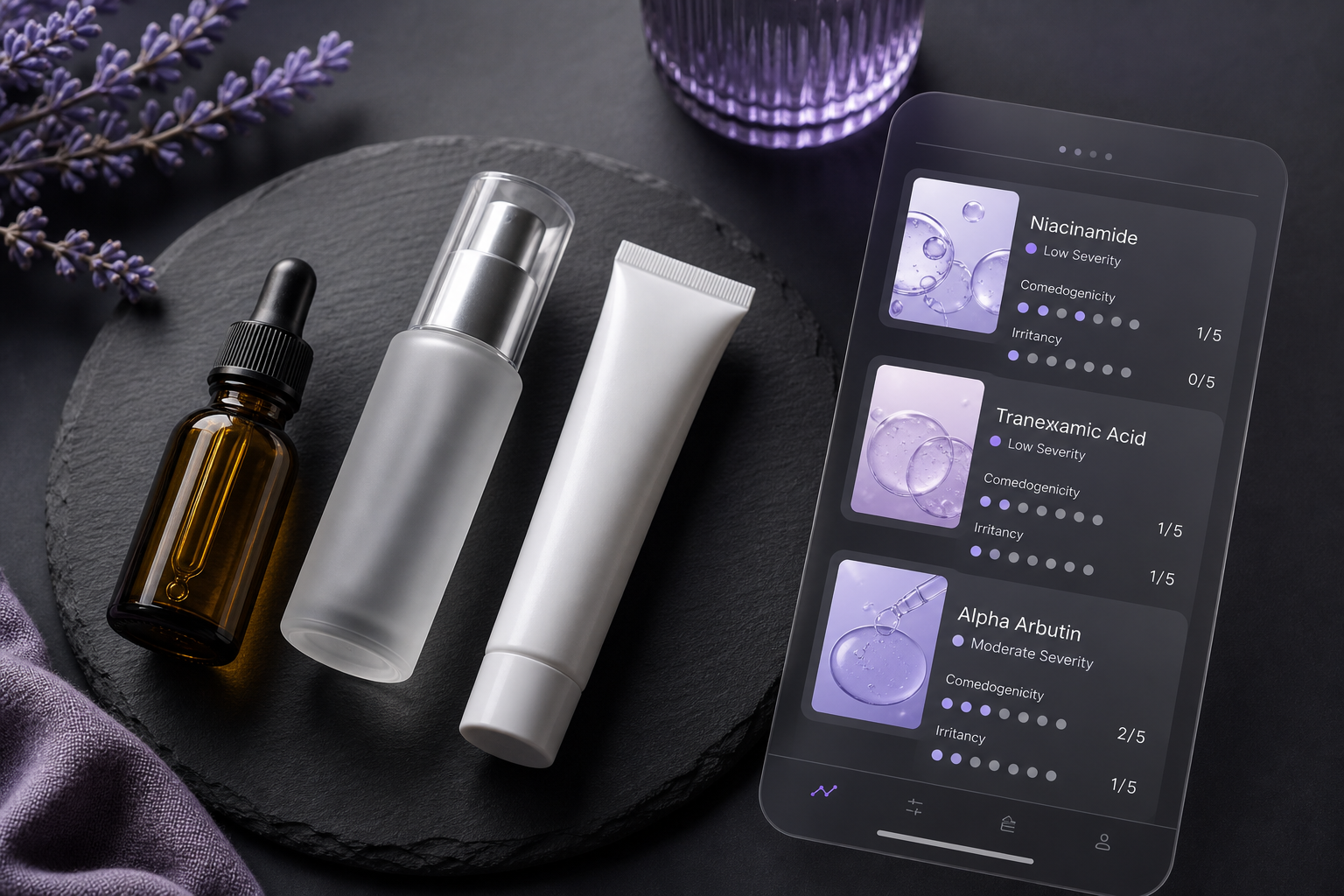
Table of Contents
- Which Skincare Ingredients Actually Fade Dark Spots
- Why Static Ingredient Spreadsheets Break at Production Scale
- How the Dermalytics API Returns Dark-Spot Ingredient Data
- Shipping a Dark-Spot Finder Feature
- Dermalytics vs. Cosmethics, INCIdecoder, INCI Beauty, and SkincareAPI.dev
- Developer FAQ — Integrating Dark-Spot Ingredient Data
- Pre-Integration Checklist
Which Skincare Ingredients Actually Fade Dark Spots — A Clinically-Backed Decision Matrix
Not every "brightening" ingredient is equal. Differentiation matters along four axes: mechanism (tyrosinase inhibition vs. melanosome transfer blockade vs. cell turnover acceleration), time to visible result (4 weeks to 24 weeks), irritancy risk (well-tolerated to barrier-disrupting), and regulatory status across jurisdictions. The matrix below distills the published evidence into the fields a structured data layer should actually surface.
| Ingredient | Mechanism | Typical Cosmetic % | Time to Visible Result | Irritancy Tier |
|---|---|---|---|---|
| Hydroquinone | Tyrosinase inhibitor | 2% OTC (US, historical); 4% Rx | 4–8 wks early; 12–16 wks max | High |
| Niacinamide | Blocks melanosome transfer | 2–5% | 8–12 weeks | Low |
| L-Ascorbic Acid | Antioxidant + tyrosinase inhibitor | 10–20% | 8–12 weeks | Moderate |
| Azelaic Acid | Tyrosinase + antibacterial | 5–10% cosmetic; 15–20% drug | 12–16 weeks | Low–Moderate |
| Kojic Acid | Tyrosinase inhibitor | 0.5–1% | 6–8+ weeks | Moderate |
| Tretinoin (Rx) | Cell turnover accelerator | 0.025–0.1% | 12–24 weeks | High |
| Retinol | Cosmetic retinoid | 0.1–1% | 12–24 weeks | Moderate–High |
| Glycolic Acid | Exfoliation + melanin mobilization | 5–10% home; 20–70% peel | Weeks; faster post-peel | Moderate–High |
| Tranexamic Acid | Anti-inflammatory + pigment inhibition | 2–5% topical | 8–12 weeks | Low |
| Licorice (glabridin) | Tyrosinase inhibitor (botanical) | 0.5–1% | Variable | Low |
Regulatory notes worth structuring separately: Hydroquinone is prohibited in EU cosmetics under Annex II of EC Regulation 1223/2009 and under FDA review for US OTC status. Azelaic acid at 15–20% is regulated as a drug product in both the US and EU. Kojic acid concentration is capped by SCCS opinions in the EU. Tretinoin is prescription-only globally.
The clinical evidence behind the matrix is more interesting than the matrix itself. Hydroquinone at 4% achieved a >75% reduction in melasma severity in 55–60% of patients after 12 weeks, per hydroquinone trials published in the Journal of the American Academy of Dermatology — making it the fastest-acting topical option on the table. Yet a split-face study comparing 4% niacinamide to 4% hydroquinone for melasma, published in the Journal of Cosmetic Dermatology, found both produced significant lightening at 8 weeks, with niacinamide showing fewer adverse effects (erythema, burning). L-ascorbic acid at 10–20% delivers visible improvement in dyschromia at 8–12 weeks according to clinical work in Dermatologic Surgery — but the molecule is highly unstable in water-based formulations, which means labeled potency at manufacture does not equal potency at use.
Hydroquinone fades spots faster, but niacinamide will not compromise your barrier. Your data layer needs to surface both — and let the user decide based on their skin history.
The developer takeaway: surfacing "vitamin C" as a tag is meaningless. Surfacing "L-ascorbic acid, 12%, irritancy 3, pH 3.2, EU permitted, FDA permitted" is actionable data. The chemistry under the marketing label is what determines whether your user sees their dark spots fade or sees a chemical burn at week three.
Why Static Ingredient Spreadsheets Break at Production Scale
A CSV of 500 "good for dark spots" ingredients looks like a feature on the architecture diagram. In production, it is a liability. Five failure modes break static lists for any team serious about ingredient-level UX.
Synonym collapse without chemical identity. "Ascorbic acid," "L-ascorbic acid," "ethyl ascorbic acid," "ascorbyl glucoside," "magnesium ascorbyl phosphate (MAP)," and "ascorbyl palmitate" are not interchangeable. L-ascorbic acid (CAS 50-81-7) at 10–20% has decades of RCT data in Dermatologic Surgery. Ascorbyl glucoside (CAS 129499-78-1) at 2% has limited human efficacy data. A spreadsheet keyed on "vitamin C" treats them as one entity. An ingredient API with CAS and EC identifiers does not. Get this wrong and your "vitamin C serum" filter returns a product whose active ingredient has never been proven to fade a single spot in a controlled trial.
Regulatory drift across jurisdictions. Hydroquinone is prohibited in EU cosmetics under EC Regulation 1223/2009 Annex II, under FDA review for OTC status in the US, and treated separately under Health Canada's cosmetic ingredient hotlist. A US-built app shipping to EU users without jurisdictional flags will surface banned actives. Sunscreen labeling has the same problem: the EU requires UVA-PF ≥ 1/3 of labeled SPF, while the FDA requires meeting separate broad-spectrum criteria. The American Academy of Dermatology recognizes broad-spectrum SPF 30+ as "essential" adjunctive therapy for any dark-spot regimen — but the label "broad spectrum" does not mean the same thing on a French tube as it does on a US one.
Concentration context invisible in marketing copy. INCI lists are ordered by descending concentration only above 1%. Exact percentages are rarely disclosed. Niacinamide at 4% is therapeutic for melasma. Niacinamide at 0.3% is a marketing claim and a barrier-support afterthought. Without structured concentration metadata and INCI position rank, an app cannot meaningfully sort products by therapeutic potential.
Combination irritancy stacking. Retinoids plus AHAs over 10% plus L-ascorbic acid at pH below 3 creates compounding irritation risk. Higher-risk-in-sensitive-skin actives include hydroquinone, AHAs over 10%, prescription retinoids, and low-pH vitamin C, per reviews in JAAD and Dermatologic Therapy. A static list of "good for dark spots" ingredients cannot detect that a single product stacks three high-irritancy actives — but a batch INCI analyzer with per-ingredient irritancy scores can flag the stack before your user buys it.
Real-time regulatory updates. Kojic acid concentration limits have been revisited by SCCS. Hydroquinone OTC status in the US has shifted multiple times. EU Annex updates publish quarterly. Manual lists go stale within weeks. Programmatic data layers query a maintained source; spreadsheets become technical debt the day after they're approved.
Your spreadsheet does not know that vitamin C in one product is ten times more potent than the vitamin C in another. A structured ingredient API does.

How the Dermalytics API Returns Dark-Spot Ingredient Data — Endpoint Anatomy
Structured ingredient data resolves all five failure modes — but only if the endpoint contract returns the right fields. Two endpoints carry the load for dark-spot use cases: a single-ingredient lookup and a batch INCI analyzer.
Single-Ingredient Lookup
GET /v1/ingredients/{name} returns a normalized ingredient record. For a dark-spot active, that record includes: canonical name, synonyms array, CAS and EC identifiers, function category array (e.g., tyrosinase_pathway_modulator), comedogenicity score (0–5), irritancy score (0–5), severity label, regulatory status per jurisdiction (FDA, EU CosIng, Health Canada), typical concentration range, and molecular weight. Niacinamide is the cleanest worked example because it's the safest cross-jurisdictional dark-spot active in the matrix:
GET /v1/ingredients/niacinamide

{
  "name": "Niacinamide",
  "cas": "98-92-0",
  "ec": "202-713-4",
  "synonyms": ["Nicotinamide", "Vitamin B3", "3-Pyridinecarboxamide"],
  "function": ["tyrosinase_pathway_modulator", "barrier_support"],
  "comedogenicity": 0,
  "irritancy": 1,
  "severity_label": "low_concern",
  "typical_concentration_range": "2-5%",
  "regulated_in": {
    "FDA": "permitted",
    "EU_CosIng": "permitted",
    "Health_Canada": "permitted"
  },
  "safety_status": "safe"
}
Two fields are doing most of the work here. The function array tells your UI that niacinamide hits a dark-spot pathway and supports the barrier — so it can appear in two different filter facets without duplication. The regulated_in object lets you fork rendering logic per user locale without maintaining a parallel jurisdiction map.
Batch INCI Analysis
POST /v1/analyze accepts a full INCI list — the ingredient deck you'd paste from a product label — as input. Output is a scored formulation summary: overall safety_status, per-ingredient severity labels, detected actives grouped by function category, potential conflict warnings (such as a retinoid plus AHA plus low-pH vitamin C stack), and a confidence score on the match. Sub-100ms median latency. 99.9% uptime SLA. The pricing model charges credits only on successful matches — not on failed lookups or unmatched strings — which means a typo or a novel ingredient name doesn't burn through your budget.
The catalog indexes over 25,000 ingredients normalized from FDA, EU CosIng, and Health Canada sources. The full API contract is published as OpenAPI 3 at api.dermalytics.dev, with official SDKs on npm and PyPI.
Why the Structure Matters for Dark-Spot UX
A user uploads or scans an INCI list. Your app calls /v1/analyze. The response includes three ingredients tagged tyrosinase_pathway_modulator: niacinamide (irritancy 1), kojic acid (irritancy 3), and L-ascorbic acid (irritancy 3). Your UI can now render: "This formula targets dark spots through three active pathways. Two of these may cause irritation on sensitive skin." No manual ingredient research. No editorial maintenance burden. No hand-curated mapping between marketing claims and chemistry.
This is the architectural difference between regulatory-source structured data and crowdsourced ingredient education sites like INCIdecoder [VENDOR SOURCE], which excel at consumer-facing context but were not built for programmatic ingestion at scale.

Shipping a Dark-Spot Finder Feature — Five-Step API Integration Blueprint
Concrete implementation path. Not a code tutorial — a sequenced decision and integration map for the engineering lead scoping a sprint.
1. Define the user-intent surface. Decide whether your app answers "which products in our catalog contain dark-spot actives" (catalog-side analysis, batch overnight job) or "which actives in this scanned product target hyperpigmentation" (real-time, in-session). The first is a one-time-per-SKU batch. The second is per-user-session. Credit consumption between the two patterns differs by roughly an order of magnitude. Both endpoints support both patterns; the architectural choice belongs to you, and it should be made before the first API call.
2. Ingest the INCI list. Sources include supplier feeds (structured but often proprietary), barcode lookup services, user-submitted photos through an OCR pipeline, or manual brand-supplied data. Normalize to a comma-delimited or array format before passing to /v1/analyze. Strip parenthetical disclosures such as "(may contain)" or "(±)" before submission — they confuse matching logic and inflate failed-lookup noise in your logs.
3. Call POST /v1/analyze with the full deck. One request, sub-100ms median latency, returns severity labels per ingredient, overall safety_status, and active-function tags in a single payload. Do not call /v1/ingredients/{name} in a loop across the deck. Batch is cheaper (credits are charged per successful match, not per request) and faster (one network round trip versus thirty). The loop pattern is the single most common architectural mistake teams make on day one.
4. Filter the response for dark-spot-relevant actives. Filter the response where function contains tyrosinase_inhibitor, melanin_transfer_blocker, or cell_turnover_accelerator. Rank surviving ingredients by INCI position — position 1 through 5 indicates likely active concentration, position 15 and beyond indicates a trace inclusion. Cross-reference irritancy score against the user's declared skin sensitivity profile if your app collects one. The output of this step is the data your UI actually renders.
5. Render with confidence markers. Display each surfaced active with: function category translated into plain English ("blocks melanin production"), expected timeline from the clinical matrix, irritancy score with a visual badge, and a jurisdictional flag. For users in EU markets, suppress or warn on products containing hydroquinone under Reg. 1223/2009. Pair every dark-spot recommendation with sunscreen messaging — the AAD designates broad-spectrum SPF 30+ as non-negotiable adjunctive therapy, and your UI should reflect that.

Dermalytics vs. Cosmethics, INCIdecoder, INCI Beauty, and SkincareAPI.dev — Feature Comparison
Position matters when scoping vendor selection for a developer use case. The table below compares the data sources most teams evaluate when building dark-spot ingredient lookup at scale. All competitor cells reference public feature documentation and are flagged accordingly.
| Capability | Dermalytics | Cosmethics | INCI Beauty | INCIdecoder |
|---|---|---|---|---|
| Access model | REST API + SDKs | Web portal | Portal + limited API | Web portal |
| Regulatory sources | FDA + EU + Canada | EU-primary | EU-primary | Crowdsourced |
| Batch INCI endpoint | POST /v1/analyze | Not exposed | Limited | Not exposed |
| Indexed ingredients | 25,000+ | Not stated | Not stated | Crowd-extended |
| Pricing model | Credit (on match) | Subscription | Freemium | Freemium |
Competitor capability claims sourced from public feature documentation [VENDOR SOURCE].
SkincareAPI.dev sits in the same developer-API category but does not publicly publish latency targets, multi-jurisdiction regulatory mapping, or indexed-ingredient counts in its documentation [VENDOR SOURCE]. It exposes a REST endpoint for single-ingredient lookup with per-call pricing.
Three developer contexts illustrate where the differences become operational.
Mobile ingredient-scanner apps need sub-100ms in-session lookups. Consumer-facing web destinations are not architected for programmatic consumption at the latency budget a real-time scanner requires [VENDOR SOURCE]. A 600ms web-portal response is fine for a curious shopper and unacceptable for an app reading a barcode at the checkout aisle.
E-commerce catalogs serving global markets must reflect that hydroquinone is permitted (under review) in the US and prohibited in EU cosmetics under EC Regulation 1223/2009. A data layer indexing FDA, EU CosIng, and Health Canada flags this automatically. EU-primary sources may miss US-specific status nuance [VENDOR SOURCE]; crowdsourced sources may surface community sentiment rather than current regulatory fact [VENDOR SOURCE].
Cost predictability at high volume favors a credit-based model charged only on successful matches. A 30-ingredient INCI list passed through a batch analyzer consumes credits equal to the matched-ingredient count, not the request count. Per-call APIs charge whether the lookup succeeds or fails — which means typos, novel ingredients, and OCR noise all draw down your budget.
Consumer ingredient databases excel at educating shoppers. A structured ingredient API is built for developers who need sub-second, programmatic dark-spot lookups at scale.
The legitimate strengths of the competitor set deserve acknowledgment. Cosmethics and INCIdecoder produce strong consumer-facing ingredient education with community context. INCI Beauty has meaningful brand recognition in European consumer markets. None of these tools are built for the developer-integration use case targeted by a REST-first ingredient API.

Developer FAQ — Integrating Dark-Spot Ingredient Data Without the Edge-Case Traps
Q1: How do I tell if an ingredient is functioning as a dark-spot active or as a humectant in the formula?
Cross-reference the function array — which returns multiple categories for many ingredients — with INCI position. Niacinamide returns both tyrosinase_pathway_modulator and barrier_support. At INCI position 3 in a serum at typical 4–5%, it's therapeutic for melasma per the Journal of Cosmetic Dermatology comparative trial. The same ingredient at position 18 in a moisturizer is likely a barrier-support add-in. Function tags plus position rank equals intent inference, and intent inference is what your UI labels should reflect.
Q2: A user has sensitive skin — should my app block certain dark-spot actives?
Don't block. Surface risk. Filter on the irritancy score (0–5). Niacinamide (1) and licorice extract (1) are broadly tolerated. Hydroquinone, prescription retinoids, AHAs over 10%, and low-pH L-ascorbic acid sit in the higher tiers per JAAD and Dermatologic Therapy reviews. Render a warning badge when irritancy is at or above 3 and the user profile flags sensitivity. Letting users make informed choices is better UX than hiding options they may legitimately want.
Q3: How do I handle a dark-spot ingredient that's permitted in one country but banned in another?
Read the regulated_in object per jurisdiction. Hydroquinone returns permitted (under review) for FDA and prohibited for EU_CosIng under Regulation 1223/2009. Match against the user's shipping address or app locale. Either suppress the product or display it with a clear "not available in your region" notice. Never assume one regulatory frame globally — that assumption is the single most common compliance bug in catalogs that ship internationally.
Q4: How does credit-based pricing scale for a high-traffic skincare app?
Credits are charged per successful match, not per request. A POST /v1/analyze call with a 30-ingredient INCI list consumes credits equal to the count of matched ingredients. Failed lookups — typos, novel ingredients, OCR noise — are not charged. For a catalog of 10,000 products analyzed once and cached, total credit consumption is bounded by the count of unique matched ingredients across the catalog, not by user query volume. Cache invalidation is what gates your monthly bill, not traffic.
Q5: Can I cache responses, or must I hit the API every time?
Caching is appropriate for read-heavy patterns; ingredient chemistry is stable. Regulatory status is not — EU CosIng publishes Annex updates quarterly, FDA hydroquinone status has shifted, SCCS has revisited kojic acid limits. Recommended invalidation cadence: quarterly refresh on the regulated_in field; longer-lived caches for irritancy, comedogenicity, and cas. Always cache key on the canonical ingredient name returned by the API, not on the user-input string — synonym variance will fragment your cache otherwise.
Q6: What about newer actives like tranexamic acid and alpha-arbutin — is the data trustworthy?
Yes for chemistry and regulatory status, with caveats for clinical effect size. Early RCTs for topical tranexamic acid (2–5%) show melasma improvement at 8–12 weeks in JAAD and Dermatologic Surgery trials, but studies remain small and heterogeneous. The API returns the regulatory and safety profile honestly; it does not promise efficacy claims your marketing might. Display "emerging evidence" copy alongside these actives so user expectations match the published evidence base.
Pre-Integration Checklist — Decisions to Lock Before You Wire the Dark-Spot Feature
Eight decisions belong on the table before sprint planning. Each one closes off a category of rework that teams typically discover three weeks into integration.
1. Decide your call pattern: real-time per-session or scheduled catalog batch. A scanner app needs /v1/analyze on-demand. A merchandising platform pre-computes overnight. The architectural fork sets your credit forecast, your latency budget, and your caching strategy. Picking both is fine, but they belong in separate services.
2. Map your user jurisdictions and lock your regulated_in filter logic. US-only? EU? Global? Hydroquinone-containing products must be suppressed for EU users under Reg. 1223/2009. Build the locale-to-jurisdiction map and confirm your user model carries a reliable locale field before the first API call goes out.
3. Define your sensitivity-profile schema in the user model. If you want to gate or badge results by irritancy score, your user profile needs a sensitivity flag. Without it, you cannot meaningfully badge retinoids, high-strength AHAs, or low-pH vitamin C against a user's actual skin context.
4. Choose your INCI ingestion path. Supplier feed, barcode service, OCR pipeline, or user upload. Each has a different normalization step and a different failure profile. OCR pipelines need fuzzy-match tolerance; supplier feeds need duplicate-key reconciliation. Standardize the output format before submitting to the API.
5. Decide which active-function categories your dark-spot finder surfaces. Tyrosinase inhibitors only? Or also cell-turnover accelerators (retinoids) and exfoliants (AHAs)? Narrower scope produces a clearer user experience. Broader scope produces more comprehensive results and a longer education burden in your UI copy.
6. Set your cache strategy and TTL. Quarterly refresh on regulated_in. Longer TTLs on cas, comedogenicity, and irritancy. Cache key on the canonical API-returned name, not the user input string. Document the invalidation cadence in your runbook so the next engineer doesn't ship a six-month-stale regulatory flag.
7. Build your "expected timeline" UX copy from clinical sources. L-ascorbic acid at 10–20% delivers improvement at 8–12 weeks per Dermatologic Surgery. Hydroquinone at 4% shows early change at 4–8 weeks and maximal results by 12–16 weeks per JAAD. Azelaic acid lands at 12–16 weeks per EMA and FDA labeling. Tell users what's realistic. Clinical timelines pair with consistent sunscreen adherence — without the second, the first does not hold.
8. Plan how you display the sunscreen requirement. Every dark-spot UX must surface that broad-spectrum SPF 30+ daily is essential adjunctive therapy per AAD guidance. Recurrence and worsening of hyperpigmentation are common despite active treatment when photoprotection is inconsistent. A feature that recommends actives without surfacing sunscreen ships an incomplete clinical picture — and your users will feel the gap in their results.