Terrasil Skin Repair Review: Does It Really Work for Damaged Skin?
Table of Contents
- What's Actually Inside Terrasil Skin Repair
- Marketing Claims vs. Available Evidence
- Skin Conditions Where Terrasil Actually Fits
- Price-Per-Ounce Reality
- What Buyers Actually Report
- Terrasil vs. CeraVe, Aquaphor, Eucerin, and Vanicream
- How to Apply Terrasil for Best Results
- Common Questions Buyers Ask
You've tried CeraVe. You've tried Eucerin. Maybe a tub of Aquaphor still sits in the bathroom drawer. And the eczema patch on your elbow, the post-laser flake on your cheek, or the windburn cracks across your knuckles still aren't calming down the way the reviews promised.
Then you hit Amazon, Walmart, or iHerb and the algorithm surfaces Terrasil Skin Repair — a small 1-ounce jar with a 4-star average, language about "activated minerals," and a price tag two to three times what you'd pay for a drugstore cream. The reviews skew positive but vague. The marketing sounds clinical. The price doesn't. You want to know whether Terrasil Skin Repair is an actual barrier-repair product worth the premium, or whether it's petrolatum and beeswax dressed up in homeopathic branding.
Here's the framing that matters before you spend $25: Terrasil is sold by Aidance Scientific as a homeopathic OTC topical. According to HealthMatch, it falls under the FDA's "unapproved homeopathic product" category — meaning the agency has not evaluated its efficacy claims the way it evaluates approved OTC drug-monograph products. That's not automatically disqualifying. But it changes how you should read the marketing.
This review delivers four things: what's actually in the jar, which claims have evidence and which don't, which skin situations it suits and which it doesn't, and whether the spend beats a $12 tub of CeraVe.
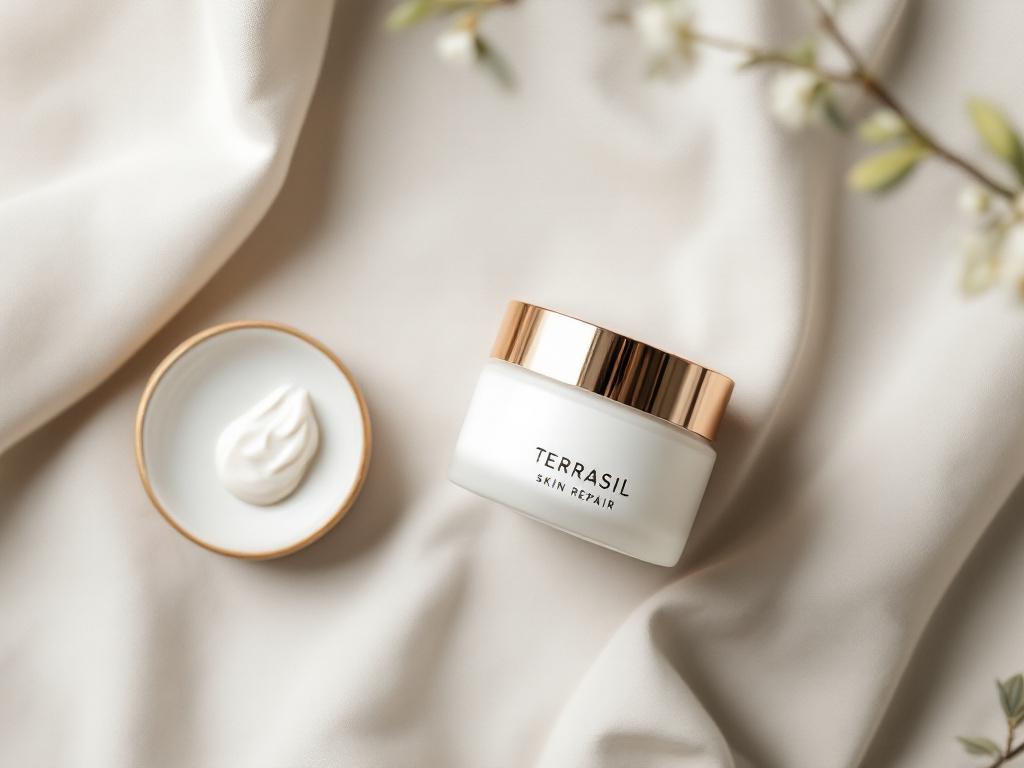
What's Actually Inside Terrasil Skin Repair — Ingredient Breakdown
Read the label and the ingredient list splits cleanly into three buckets. Aidance positions the homeopathic actives as the workers; the cosmetic chemistry tells a different story.
The Homeopathic "Actives"
Two ingredients carry the homeopathic billing on the Aidance Scientific product page (VENDOR SOURCE):
- Natrum Muriaticum — homeopathic sodium chloride, listed at high dilution. Functionally trace-level.
- Ranunculus Bulbosus — homeopathic bulbous buttercup, same dilution caveat.
This is the category HealthMatch flags as "unapproved homeopathic" by FDA standards. At homeopathic dilution levels, these contribute essentially no measurable pharmacological activity — and available independent commentary explicitly notes the lack of robust clinical research validating them as actives.
The Functional Inactive Ingredients
This is where the actual skin effects almost certainly originate:
- Petrolatum — occlusive. Forms a physical film that reduces transepidermal water loss (TEWL). The most-studied moisturizer ingredient in dermatology.
- Beeswax — emollient and structural thickener; contributes to the balm-like texture.
- Jojoba oil and sunflower oil — emollients with lipid profiles close to skin's own sebum.
- Silver oxide — antimicrobial trace ingredient, common in wound-adjacent formulations.
- Magnesium oxide and zinc oxide — listed by Aidance as "activated minerals." In cosmetic chemistry these function as mild astringents and surface buffers, not as barrier rebuilders.
- Tea tree (melaleuca) oil — aromatic and mildly antimicrobial. Also a known sensitizer for a meaningful minority of users; flagged consistently in fragrance-sensitive consumer reviews.
What's Deliberately Absent
Aidance markets these omissions, and they are accurate as listed: no added synthetic fragrance (tea tree provides the natural scent), no parabens, no sulfates, no corticosteroids, no antibiotics.
| Ingredient Category | What's Listed | Functional Role |
|---|---|---|
| Homeopathic actives | Natrum Muriaticum, Ranunculus Bulbosus | Trace dilution; minimal measurable activity |
| Occlusives | Petrolatum, beeswax | Reduce water loss; form surface film |
| Emollients | Jojoba oil, sunflower oil | Soften surface; match skin lipid profile |
| Mineral additives | Magnesium, zinc, silver oxides | Astringent / antimicrobial surface effect |
| Botanical | Tea tree (melaleuca) oil | Aromatic; potential sensitizer |
The honest analytical read: the product's plausible mechanism is occlusive-emollient barrier protection driven by petrolatum, beeswax, and seed oils — not the homeopathic actives the marketing centers on. This places Terrasil in the same functional category as Aquaphor or a Vaseline-based balm, with botanical inclusions layered on top. The "activated minerals" framing is a vendor descriptor, not an established cosmetic chemistry term.
Compared on formulation category alone (not efficacy) against three peers using their public INCI listings:
- CeraVe Moisturizing Cream — ceramides 1/3/6-II + hyaluronic acid + petrolatum. A hydration-and-barrier dual approach.
- Eucerin Advanced Repair — ceramide-3 + glycerin + urea. Humectant-forward.
- Aquaphor Healing Ointment — 41% petrolatum + lanolin + glycerin. Pure occlusive.
Terrasil sits closest to Aquaphor in functional category — an occlusive-led balm — rather than to the humectant-and-ceramide-led approach of CeraVe and Eucerin. That positioning matters when you decide what condition you're treating.
Marketing Claims vs. Available Evidence — A Reality Audit
Aidance markets Terrasil with language like "clinically tested," "doctor recommended," and "fast-acting skin repair." Audit each claim against what's actually publicly verifiable, and the picture sharpens fast.
| Marketed Claim | Verifiable Evidence Status | Notes |
|---|---|---|
| "Clinically tested" | No published peer-reviewed trials located | Vendor references internal testing only |
| "Doctor recommended" | Anonymous physician quotes on vendor site | No named clinicians or institutions [VENDOR SOURCE] |
| "Repairs damaged skin" | Plausible from occlusive-emollient formulation | Claim itself not FDA-evaluated |
| "Natural formula" | Partial — botanicals plus petrolatum | "Natural" is unregulated as a descriptor |
| "Fast-acting" | Customer reviews report 1–4 weeks | Vendor language implies faster |
| FDA approval | Unapproved homeopathic OTC | Source: HealthMatch |
What does "unapproved homeopathic" actually mean in the U.S. OTC landscape? According to HealthMatch, the FDA has not evaluated these products for efficacy in the way it evaluates approved OTC drug monograph products like hydrocortisone 1% or salicylic acid acne treatments. This is not the same as "banned" or "unsafe" — many homeopathic products are sold legally in the U.S. — but it does mean efficacy claims have not been independently validated by a regulator.
What can "clinically tested" legally mean in OTC marketing? It can refer to vendor-funded usability or tolerability testing on small panels without peer review, and there is no obligation to publish results. Without a citable study — sample size, design, outcomes — the claim functions as marketing copy, not evidence.
Be precise about where the product likely does help: the occlusive-emollient effect of its inactive ingredients is real and well-established in dermatology generally. Petrolatum-led balms reduce TEWL. Beeswax and seed oils soften surface texture. Those mechanisms work whether the label says "Terrasil" or "Aquaphor." The benefit attributed to the homeopathic actives, by contrast, is not supported by available sourcing.
This is a fair framing, not a hostile one. The product can still be useful for the right user. The marketing oversells the mechanism that powers it.
The plausible benefit of Terrasil Skin Repair comes from petrolatum, beeswax, and seed oils doing standard occlusive work — not from the homeopathic actives the marketing centers on.
Skin Conditions Where Terrasil Actually Fits — Use-Case Mapping
Efficacy is condition-specific. Terrasil Skin Repair is not a universal "damaged skin" solution, and treating it as one wastes money and time. Map the formulation logic from the previous section against the six most common reasons people search for a repair cream.
The occlusive-emollient profile is most logically suited to these use cases:
- Post-procedure surface irritation (mild). After mild chemical peels, microdermabrasion, or minor cosmetic procedures where skin needs occlusion to retain moisture and reduce TEWL during early healing. The petrolatum-beeswax base functions similarly to Aquaphor in this role.
- Chapped, windburned, or weather-damaged skin. Where the issue is surface dehydration and microcracks rather than inflammation. Occlusion is the mechanism that helps, and Terrasil delivers it.
- Mild eczema dryness between flares. As a barrier-maintenance moisturizer when skin is stable, not as a treatment during an active inflammatory flare. Aggregated customer reviews from Walmart and iHerb cluster the strongest positive feedback around this maintenance use case.
- Localized rough patches (elbows, knuckles, heels). Thick, keratinized skin tolerates the heavier texture well; occlusion-driven softening works predictably here.
Where it doesn't fit, the decision matrix is the clearer guide:
| Skin Condition | Fit | Why | Better Option |
|---|---|---|---|
| Active eczema flare (weeping) | Poor | Not anti-inflammatory | OTC hydrocortisone 1% or Rx steroid |
| Maintenance between eczema flares | Reasonable | Barrier support fits the need | CeraVe Moisturizing Cream |
| Post-laser / post-peel days 1–5 | Reasonable | Heavy occlusion suits healing | Aquaphor |
| Acne-prone skin | Poor | Occlusion + tea tree may aggravate | Lightweight gel moisturizer |
| Rosacea / facial redness | Poor | Tea tree is a facial sensitizer | Centella or niacinamide cream |
| Chapped lips, knuckles, dry patches | Reasonable | Standard occlusive role | Vaseline or Aquaphor |
| Diabetic skin / serious wounds | Not appropriate | Unapproved homeopathic; not wound care | Clinician-directed wound dressing |
Notice the recurring theme. Where Terrasil fits, cheaper occlusives often fit equally well. The honest "Terrasil-specifically" case emerges when a user is fragrance-sensitive but tolerates tea tree, prefers a non-petrolatum-dominant texture, or has already failed cheaper occlusives for tolerability reasons.
That's a real buyer profile. It's also a narrow one.
Price-Per-Ounce Reality — Is Terrasil Worth the Premium?
Terrasil Skin Repair retails for approximately $20–$32 for a 1-ounce jar across Walmart, iHerb, and Target (confirm current pricing at purchase). That sounds reasonable until you do the per-ounce math against category-equivalent products.
| Product | Approximate Retail | Size | Approx. Price per Ounce |
|---|---|---|---|
| Terrasil Skin Repair | $20–32 | 1 oz | $20–32 |
| Aquaphor Healing Ointment | $10–14 | 14 oz | ~$0.70–1.00 |
| CeraVe Moisturizing Cream | $15–19 | 16 oz | ~$0.95–1.20 |
| Eucerin Advanced Repair | $12–16 | 16 oz | ~$0.75–1.00 |
| Vanicream Moisturizing Cream | $14–18 | 16 oz | ~$0.90–1.15 |
The honest math: Terrasil costs roughly 20–40 times more per ounce than category-equivalent occlusive or barrier creams. The price gap isn't subtle — it's structural to the brand positioning.
What is a reasonable buyer actually paying for at that premium?
- A small jar size (1 oz) suited to spot-treatment, not body-wide use
- A homeopathic-positioned brand with no synthetic fragrance, no sulfates, and no parabens
- The botanical inclusions — jojoba, tea tree — absent from Aquaphor or generic petrolatum
- The marketing ecosystem: branded packaging, retailer return policies, support channels
When the premium is defensible:
- Spot-treating a small area (a single eczema patch, a healing scab, a peel-irritated cheek) where 1 oz lasts 3–5 weeks
- The user has already failed cheaper occlusives due to fragrance reactions or specific sensitivities — and tolerates tea tree
- A travel or single-use scenario where size and packaging matter more than cost-efficiency
When the premium is not defensible:
- Body-wide eczema or dry skin where 1 oz lasts days, not weeks
- Maintenance use where Aquaphor or CeraVe deliver the same mechanism at a fraction of the cost
- First-line trial for an unfamiliar condition — start cheap, escalate if needed
Purchase channels include the official Aidance site, Amazon, Walmart, iHerb, and Target. Return policies vary by retailer; Amazon and the official manufacturer site historically offer the most generous handling of opened cosmetic returns, but verify current policy language at time of purchase rather than assuming.
At 20 to 40 times the per-ounce cost of Aquaphor, Terrasil only earns its premium when you've genuinely failed cheaper occlusives — not as a first-line trial for a condition you haven't yet matched to a mechanism.
What Buyers Actually Report — Reading Reviews Without Getting Played
Reviews on retail platforms are useful data, but only if you read them with the right filters. Terrasil reviews include a mix of (a) organic users with real skin conditions, (b) incentivized review-club participants common to small-batch brands, and (c) skeptical one-star reviewers whose conditions may never have matched the formulation's actual mechanism. All three are signal, not noise — if you know how to weight them.
Four recurring clusters appear across Walmart, iHerb, and Target review data:
- Pattern 1: "It worked over 2–4 weeks for my chronic dryness or eczema-adjacent patches." The most common positive cluster. Users describe consistent application, modest expectations, and improvement aligned with what an occlusive-emollient base would plausibly deliver. These reviews tend to be specific about condition, duration, and frequency — markers of authenticity.
- Pattern 2: "Helped after [specific procedure or event]." Post-laser, post-peel, post-shaving, post-windburn anecdotes. Plausible mechanism match. Timelines are typically shorter — days, not weeks.
- Pattern 3: "Didn't work for my [acute condition]." Often involves active eczema flares, fungal infections, or conditions that require anti-inflammatory or prescription treatment. The product is being asked to do something its formulation cannot.
- Pattern 4: "Too greasy, too expensive, or the tea tree smell bothers me." Texture and price complaints are consistent across platforms. Tea tree scent is a recurring sensitivity issue and the most common reason fragrance-sensitive users abandon the product.
How to weight a review when you read it:
- Trust reviews that name the specific skin condition AND the duration of use. "Two weeks on eczema patches around my elbow" is signal. "Works great!" with no context is noise.
- Discount reviews with no skin-type or condition specificity. They tell you nothing about whether the product will work for you.
- Look at the 2-star and 3-star reviews. They're often the most analytically useful, showing partial efficacy and helping you predict your own outcome more accurately than 5-star praise.
- Note the condition match between reviewer and yourself. A 5-star average from users treating chapped knuckles tells you little if you're managing post-laser irritation.
Customer reviews are not clinical evidence, but they are a valid signal for tolerability and texture experience — two things clinical trials rarely capture well anyway. A 4-star average with a clear cluster of "worked for my mild eczema between flares" reviews is genuinely more useful than a 5-star average built on vague praise.
Terrasil vs. CeraVe, Aquaphor, Eucerin, and Vanicream — Direct Comparison
Build the head-to-head strictly from publicly available INCI lists and retail pricing, and the picture clarifies. This is not an efficacy ranking — it's a mechanism-and-cost matrix that lets you match your condition to the right tool.
| Product | Core Mechanism | Texture | Best Use Match | Approx. Price/oz |
|---|---|---|---|---|
| Terrasil Skin Repair | Occlusive + botanical + homeopathic | Heavy, balm-like | Spot treatment; fragrance-sensitive who tolerate tea tree | $20–32 |
| Aquaphor Healing Ointment | Pure occlusive (41% petrolatum) | Heavy, greasy ointment | Post-procedure, severe dryness | ~$0.70–1.00 |
| CeraVe Moisturizing Cream | Ceramide + humectant + light occlusive | Medium cream | Daily barrier maintenance | ~$0.95–1.20 |
| Eucerin Advanced Repair | Ceramide + humectant + urea | Medium cream | Rough, dry, sensitive skin | ~$0.75–1.00 |
| Vanicream Moisturizing Cream | Minimalist barrier (no fragrance/dye) | Medium cream | Reactive, allergy-prone skin | ~$0.90–1.15 |
Public INCI references: CeraVe, Aquaphor, Eucerin, Vanicream.
When CeraVe is the rational pick. Daily, body-wide barrier maintenance for someone with general dryness or mild eczema between flares. The ceramides 1, 3, and 6-II plus hyaluronic acid attack the problem from two angles — replenish skin lipids and draw water into the stratum corneum. The 16-ounce tub lasts months. If your damage reads as "skin feels dry, tight, and dehydrated," CeraVe is functionally a better mechanism match than Terrasil. The terrasil vs cerave question is almost always decided by surface area and frequency of use, and CeraVe wins both.
When Aquaphor is the rational pick. Acute post-procedure recovery (tattoos, peels, lasers), severely chapped lips and hands, or any situation where a dermatologist's first instinct is "occlude it and leave it alone." Aquaphor is, in mechanism, the unbranded version of what Terrasil's occlusive base does — at roughly 1/30th the per-ounce cost. If you tolerate lanolin and don't need botanicals, the substitution is direct.
When Eucerin is the rational pick. Sensitive skin that needs more humectant pull (urea draws water into the corneum more aggressively than glycerin alone) than pure occlusion. It splits the difference between CeraVe's ceramide-led approach and Aquaphor's pure occlusion. A good middle option for rough, dry skin that hasn't responded to one or the other.
When Vanicream is the rational pick. Confirmed contact allergies, fragrance reactions, or eczema that's flared from "natural" botanicals — including tea tree. Vanicream is the strictest minimalist option in this comparison: no fragrance, no dye, no parabens, no formaldehyde releasers, no lanolin. For users who think the appeal of Terrasil is its "no fragrance, no sulfates" pitch — Vanicream goes further and costs less. This is often the missed terrasil alternative for genuinely reactive skin.
When Terrasil specifically wins. A narrow case. The user has tried at least one of the above, found a specific intolerance (reacts to lanolin in Aquaphor, dislikes the slick feel of pure petrolatum, wants jojoba and tea tree as the emollient profile), and is treating a small enough area that the 1-ounce jar is economically reasonable. That buyer exists. They are not the majority of buyers.
Terrasil's narrow win condition is a buyer who has already failed cheaper occlusives, tolerates tea tree, and is treating a small area — outside that profile, the price math doesn't survive scrutiny.
How to Apply Terrasil for Best Results — Step-by-Step Protocol
If you've decided the formulation matches your condition, application sequencing materially changes whether the product works. The occlusive position in a routine is non-negotiable, and skipping the patch test on a tea tree-containing balm is a documented source of avoidable reactions (Aidance Scientific application guidance, VENDOR SOURCE).
- Patch-test first (24–48 hours). Apply a pea-sized amount to the inner forearm or behind the ear. Wait 24–48 hours. If you see redness, itch, or stinging, stop. This matters especially because of the tea tree oil content, which is a known sensitizer for a meaningful minority of users.
- Cleanse with a mild, sulfate-free cleanser. Lukewarm water, never hot — hot water strips skin lipids and undoes the work you're about to do. Pat dry but leave skin slightly damp; this helps the emollient phase spread evenly.
- Apply other treatments first. If you use a prescription topical like tretinoin or tacrolimus, a serum, or a niacinamide cream, those go on first. Wait 3–5 minutes for absorption before the occlusive layer.
- Apply Terrasil as the final occlusive step. Pea-sized for a single facial area; almond-sized for body patches. Massage gently. The product should largely absorb within 2–3 minutes but will leave a faint occlusive film — that's intended, not a defect.
- In the morning, ensure full absorption before sunscreen. Wait 5–7 minutes. Layering sunscreen directly over an unabsorbed occlusive causes pilling and reduces sunscreen efficacy. For most users, this product is better used PM-only on the face.
- Use consistently for 2–4 weeks before judging results. Barrier recovery is not a three-day process. Customer review patterns cluster results around 2–4 weeks of consistent use, not the "fast-acting" timeline the marketing implies.
- Re-evaluate at the 4-week mark. If you see no improvement in your specific concern, the mechanism is not matching the condition. Stop and reconsider — you likely need a different category (anti-inflammatory, humectant-led, or prescription).
Optimal Use Protocol Checklist
- Patch-tested on inner arm, no reaction at 48 hours
- Skin cleansed and slightly damp before application
- Pea-sized for face / almond-sized for body
- Applied AFTER serums and treatments, BEFORE sunscreen
- Used consistently for at least 14 days before judging results
- Jar kept sealed; clean fingers or a spatula only
- Stop immediately if itch, burning, or worsening redness develops
- Not layered with other heavy occlusives (Aquaphor, Vaseline) on the same area
Common Questions Buyers Ask Before Hitting "Add to Cart"
Is Terrasil Skin Repair FDA-approved?
No. According to HealthMatch, this product is classified as an unapproved homeopathic OTC. It is legally sold, but the FDA has not evaluated its efficacy claims the way it evaluates approved OTC drug-monograph products like hydrocortisone 1% or salicylic acid acne treatments. This does not make it unsafe; it does mean efficacy claims should be read as marketing rather than regulatory-validated statements.
Can I use Terrasil while pregnant or breastfeeding?
Available sourcing does not provide pregnancy-specific safety data. The bulk-volume ingredients — petrolatum, beeswax, jojoba oil — are routinely considered low-risk during pregnancy in standard dermatology guidance. But tea tree oil is debated in the pregnancy literature, and the homeopathic actives have no pregnancy data in available sources. Recommendation: ask an OB-GYN or dermatologist before use during pregnancy or breastfeeding. Do not default to a "natural means safe" assumption — it isn't a reliable rule.
Can Terrasil be used with retinoids, acids, or prescription topicals?
Likely yes, with sequencing. Prescription or active treatments go on first; let them absorb 3–5 minutes; then apply Terrasil as the occlusive top layer. Occlusion can intensify the underlying treatment's effect and its potential irritation, so introduce slowly — every other night for the first week, then increase. Skip layering with other heavy occlusives like Aquaphor on the same night on the same area; doubling the occlusive layer doesn't help and traps heat.
How long does a 1-ounce jar last?
For spot-treatment of a small facial area or a single body patch, applied twice daily: roughly 3–5 weeks. For larger body areas — a forearm-sized eczema patch on both arms, for instance — about 7–14 days. This is the real cost-per-week math that determines whether the premium price is sustainable for your use case. Run the calculation before the second purchase, not after.
Where should I buy it, and what's the return policy?
Available through the official Aidance Scientific site, Amazon, Walmart, iHerb, and Target. Return policies vary by retailer; Amazon and the official manufacturer site have historically been the more generous channels for opened cosmetic returns within their standard windows. Verify current policy language at purchase time rather than relying on this article. If you're testing whether the product works for your specific condition, buying from a retailer with a clear return policy meaningfully reduces the risk of a $25 dead jar sitting in your bathroom drawer.