
Milady's Cosmetic Ingredients Dictionary vs. a Programmatic API: A Modern Alternative
What Milady's Dictionary Actually Contains (And Why Estheticians Trust It)
Milady's 2,300+ entries teach cosmetic chemistry. REST endpoints automate it. Here's how to decide which layer your skincare app, e-commerce platform, or compliance tool requires.

A product team at a DTC skincare brand is 48 hours from launching a new "transparency badge" feature on every product page. The marketing brief says: flag high-irritancy ingredients in real time, surface comedogenicity scores, and update automatically when the EU restricts something new. On the engineering Slack, someone links to the Milady's Skin Care and Cosmetic Ingredients Dictionary, 4th Edition. It lists more than 2,300 ingredients with INCI names, function notes, and skin-physiology context. It is the gold-standard reference for esthetics education. It is also a book.
The tension is structural. Milady's was engineered for human readers making slow, careful decisions at the consultation chair. A product page rendering 4,000 SKUs needs a JSON response in under 100 milliseconds. Both artifacts are correct; they solve different problems. This article maps where each one wins, where the print reference structurally cannot serve a software team, and what to evaluate if you decide a programmatic layer is required.
Table of Contents
- What Milady's Dictionary Actually Contains (And Why Estheticians Trust It)
- Three Capabilities a Print Reference Structurally Cannot Provide
- Capability Comparison: Milady's Dictionary vs. a Programmatic Ingredient API
- When Milady's Is Still the Right Tool
- How Production Teams Integrate Ingredient Data: Three Patterns
- Evaluating an Ingredient API: Eight Criteria That Separate Production-Grade from Toy
- Ingredient Data in Production: Questions Engineering Teams Keep Asking
What Milady's Dictionary Actually Contains (And Why Estheticians Trust It)
Before any argument about programmatic alternatives, the Milady's Skin Care and Cosmetic Ingredients Dictionary deserves an accurate accounting of what it is. The 4th edition is organized in three deliberate parts, and the design tells you exactly who the book was built for.
Part 1 covers skin anatomy, physiology, terminology, skin types and conditions — the framing material a practitioner needs before any ingredient discussion makes sense. Part 2 is the alphabetical dictionary itself: more than 2,300 cosmetic ingredient entries listed by INCI name "wherever possible," each with function and purpose noted. Part 3 is a dedicated Latin botanical names cross-reference index, which matters when an esthetician encounters Rosa damascena on a label and needs to trace it to "rose flower oil" (source: Milady, 4th Edition).
The historical credibility is real and traceable. The 2nd edition (2001) already contained over 2,000 ingredients with approximately 200 new or updated entries (source: Google Books listing for the 2nd edition). The 4th edition expanded coverage to 2,300+. Author lineage matters too — Varina Michalun authored the third edition, which Skin Inc. described as providing "a complete overview of skin physiology" and an overview of the "complexity of cosmetic chemistry" (source: Skin Inc.). That framing is important: the book is positioned as a learning instrument, not a data feed.
The publisher's own positioning is explicit. The 4th edition is presented as "more than just a dictionary" — "a guide to understanding skin types and skin physiology, product formulation, and how cosmetic products interact with the skin," intended as "an invaluable resource that will assist in making well-informed decisions" (source: Milady, 4th Edition). Read that sentence carefully. The book is written to a human decision-maker, not to a backend service.
Who is that human? Esthetics students preparing for state board certification. Practicing estheticians at the consultation chair. Salon owners training staff. Product educators briefing retail teams. The book's strength is teaching cosmetic chemistry context — why ceramides matter, what surfactants do, how plant extracts are named in Latin — not powering software.
For completeness, consider the cousin reference. The International Cosmetic Ingredient Dictionary and Handbook, published by the Personal Care Products Council, carries more than 13,000 INCI names cross-referenced to nearly 60,000 trade and technical names and 3,000 suppliers from 91 countries (source: CosmeticsInfo). Milady's is narrower in nomenclature scope but richer in instructional context. The two references are not in competition; they answer different questions.
That brings us to the structural constraint that motivates everything downstream. Milady's is print and PDF. It has no machine-readable schema, no export interface, no batch query mechanism. That isn't a flaw — it's a design choice consistent with the audience the book serves. The interesting question is what that choice means the moment a product team needs to ship a feature against a 4,000-SKU catalogue with regulatory updates rolling in monthly.
Milady's Dictionary is a reference; a programmatic API is infrastructure. One teaches you what ingredients do. The other lets you build features that respond to what they do.
Three Capabilities a Print Reference Structurally Cannot Provide
Print references and APIs aren't competing on quality — they're operating on different planes. Below are the three capabilities a book cannot deliver to a software product, no matter how careful its scholarship.
1. Batch formulation analysis in a single request.
Milady's and the International Cosmetic Ingredient Dictionary are both optimized for human reading and single-ingredient lookups (sources: Milady; CosmeticsInfo). An API designed for formulation work — such as the POST /v1/analyze endpoint on the Dermalytics platform — accepts a complete INCI list and returns per-row matches with severity labels, comedogenicity and irritancy scores (0–5), batch safety_status, synonyms and identifiers in a single HTTPS request (source: Dermalytics). Practical impact: a 30-ingredient sunscreen formulation is one network call instead of 30 page lookups. For a product catalogue of 4,000 SKUs, this is the difference between possible and impossible.
2. Continuous data refresh aligned with regulatory change.
Milady's expanded from "over 2,000 ingredients" in its 2nd edition (2001) to 2,300+ in its 4th — coverage grows in discrete edition cycles, not continuously (sources: Google Books, 2nd ed.; Milady, 4th ed.). Regulatory baselines — the EU Cosmetics Regulation (EC) No 1223/2009, U.S. FDA cosmetic provisions, Health Canada hotlist revisions — shift mid-cycle and without warning. SaaS-style APIs deploy regulatory metadata centrally without any customer action. Practical impact: when an EU Annex restriction publishes, an API consumer's app reflects it the same week; a print reference reflects it in the next edition.
3. Structured output for software consumption.
An ingredient API returns fields explicitly designed for "apps, backends, and AI agents" — severity labels, comedogenicity and irritancy scores (0–5), batch safety status, synonyms, and per-row matches (source: Dermalytics). Milady's entries are prose — designed to be read by an esthetics student, not parsed by a Node.js handler. There is no schema, no JSON, no field types. Practical impact: you cannot write if (ingredient.irritancy >= 4) showWarning() against a book. You can against a JSON response. The choice between the two artifacts is not about which has better information — it is about whether your downstream consumer is a human eye or a runtime.
Capability Comparison: Milady's Dictionary vs. a Programmatic Ingredient API
When the comparison is laid side by side, the pattern is not "one is better" — it's that they're built for different layers of the workflow.
| Capability | Milady's Dictionary (4th ed.) | Programmatic Ingredient API |
|---|---|---|
| Indexed ingredient entries | 2,300+ alphabetical entries¹ | Thousands of ingredients with structured metadata² |
| Primary naming standard | INCI "wherever possible," plus common/trade/chemical names¹ | INCI-keyed lookup with synonyms and identifiers² |
| Update mechanism | New print/PDF editions; 2nd ed. added 200 new entries³ | Continuous SaaS deployment; no customer action² |
| Single-ingredient lookup | Manual page navigation or PDF search¹ | GET /v1/ingredients/{name} HTTPS call² |
| Batch formulation analysis | Not supported — one entry at a time¹ | POST /v1/analyze returns per-row results² |
| Structured technical fields | Prose entries with function/purpose¹ | Severity labels, 0–5 scores, CAS/EC IDs, safety_status² |
| Programmatic integration | None — print/PDF only¹ | REST/HTTPS, npm/PyPI SDKs, bearer-token auth² |
| Educational content | Part 1: skin anatomy, physiology, conditions¹ | Not included — data only² |
| Botanical Latin index | Part 3: dedicated cross-reference¹ | Returned as synonyms within records² |
¹ Milady, 4th Edition; ² Dermalytics API; ³ Google Books, 2nd ed.
The rows are not weighted equally for every team. For an esthetics student or salon practitioner, rows 8 and 9 — educational content and the botanical Latin index — are the entire point of buying the book. For a mobile app team rendering a product detail screen, rows 4 through 7 are the only rows that matter. The same artifact looks essential to one reader and irrelevant to another, depending on which job the reader is trying to do.
The structural asymmetry is worth stating plainly. Milady's wins on contextual depth (Part 1 skin physiology, Part 3 botanical names) — content an API simply does not include. The API wins on every dimension that involves automation, scale, integration, and real-time response — dimensions Milady's was never designed for.
Coverage deserves a careful note. The 2,300+ Milady figure is a curated educational set, not an attempt at exhaustive nomenclature. By contrast, the International Cosmetic Ingredient Dictionary and Handbook documents 13,000+ INCI names with roughly 60,000 trade-name cross-references across 91 countries (source: CosmeticsInfo). A production API is closer in spirit to the Handbook than to Milady's — broad and machine-parseable rather than narrow and instructional.
The question, then, is not which artifact is "better." It is which capability your roadmap requires. If your sprint ticket reads render irritancy badge on PDP, no edition of Milady's resolves it. If your training plan reads estheticians must explain why salicylic acid affects sebum, no API resolves it.
The decision is not Milady's versus the API. It is whether your product needs to learn from ingredient data or act on it in real time.
When Milady's Is Still the Right Tool
APIs are not universally superior. Five scenarios where the Milady's Skin Care and Cosmetic Ingredients Dictionary remains the correct choice:
- Esthetics certification and curriculum. Milady's is the established reference for esthetics education and is structured as an instructional text covering skin anatomy, physiology, types and conditions before any ingredient entry (source: Milady, 4th Edition). No API duplicates this pedagogical scaffolding. State board prep, esthetics school coursework, and salon staff training all depend on it.
- Building cosmetic-chemistry literacy on a new team. Engineers and PMs entering beauty tech without a chemistry background need to understand ingredient families, functions, and the relationship between skin physiology and formulation. Skin Inc. described the third edition as providing "a complete overview of skin physiology" and the "complexity of cosmetic chemistry" (source: Skin Inc.) — onboarding material no JSON response replaces.
- Low-volume, occasional lookups. A team that looks up fewer than 10 ingredients per month does not need a credit-based API account. Milady's is a one-time purchase. The economic case for an API begins when manual lookup labor exceeds licensing cost, which for most small teams is roughly a few hundred lookups per month.
- Working in offline environments. Salon floors, clinical consultation rooms, and trade-show booths without reliable connectivity benefit from a physical book. APIs require network access; client-side caching mitigates this only partially and only after a first successful sync.
- Researching botanical and Latin-name ingredients. Part 3 of Milady's is a dedicated Latin botanical names index (source: Milady, 4th Edition). For natural-product formulators tracing Rosa damascena to "rose flower oil," the cross-reference is fast, authoritative, and self-contained on the desk.
How Production Teams Integrate Ingredient Data: Three Patterns
Once a team decides programmatic data is required, the next question is architectural — how the API gets wired into the product. Three patterns currently dominate among mobile, e-commerce, and SaaS teams, each with distinct data flows and trade-offs.
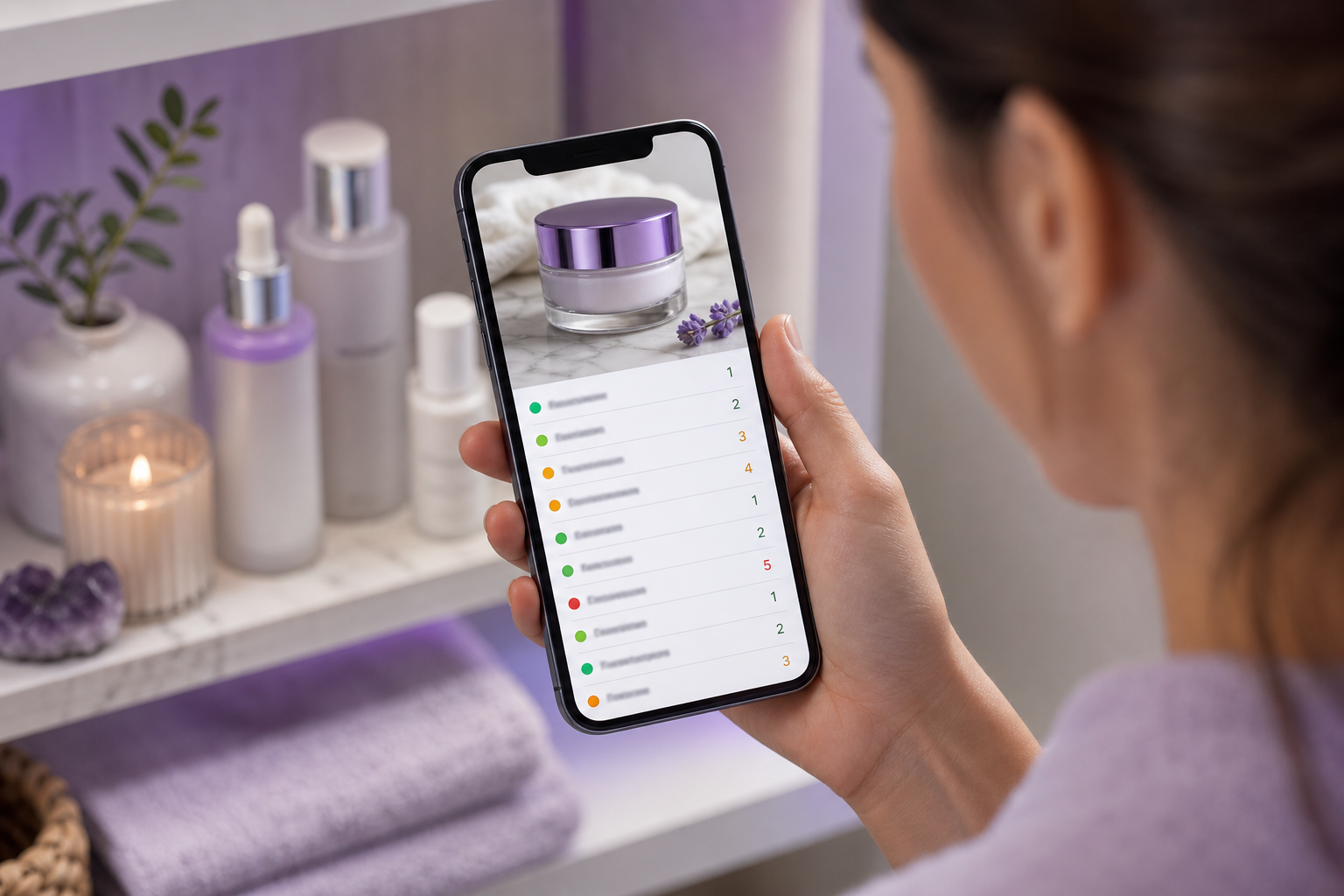
Pattern 1: The Mobile Ingredient Scanner
Persona: the consumer-facing scanner team — a mobile app that lets users photograph a product label and receive a real-time safety read.
Data flow:
- User scans a barcode or photographs the INCI panel.
- App resolves the SKU to an INCI list, either from a product database or OCR output.
- App calls
POST /v1/analyzewith the full ingredient array. - The API returns per-ingredient severity labels, comedogenicity and irritancy scores (0–5), and a batch
safety_status(source: Dermalytics). - The UI renders severity badges, allergen flags, and any conflict warnings.
Why an API serves this pattern: a 25-ingredient sunscreen needs one request, not 25. Sub-100 ms p50 latency is the general baseline for "instant" feel in mobile UIs. The same task against Milady's would require the user to wait while a human flipped pages — not a viable UX. Note the dermatology caveat covered later: scores are decision-support, not deterministic verdicts. Real reactions depend on concentration, vehicle, and individual variability. Surface scores; do not market them as guarantees.
Pattern 2: E-Commerce Product Page Enrichment
Persona: the DTC beauty brand engineering team — a Shopify, Magento, or custom storefront adding ingredient transparency to product detail pages.
Data flow:
- The product team uploads INCI lists for the catalogue via CSV or admin form.
- A nightly job iterates SKUs and calls
POST /v1/analyzewith each formulation. - Returned structured data — INCI names, CAS/EC identifiers, synonyms, comedogenicity and irritancy scores,
safety_status— is persisted in the product database. - PDPs render an "Ingredient Transparency" block populated from the cached fields.
Why an API serves this pattern: structured fields drive SEO (each ingredient becomes indexable structured content) and customer trust. A credit-based pricing model — charged only on successful matches (source: Dermalytics) — means the brand pays for hits, not misses. Continuous central updates mean the catalogue reflects new EU restrictions without engineering work on the store side. Compliance note: regulators (EU Cosmetics Regulation (EC) No 1223/2009; FDA) place ultimate responsibility on the manufacturer's safety assessor. The API is decision support; the legal sign-off remains with the brand.
Pattern 3: SaaS Compliance Dashboard for Formulation Teams
Persona: the internal compliance tooling team — building an internal dashboard for the formulation lab and regulatory affairs.
Data flow:
- A chemist updates a formulation in the internal tool.
- On save, the backend calls
POST /v1/analyze. - The response is checked against allow/deny rules — for example, "block any ingredient flagged under an EU Annex II restriction."
- Flags surface in the dashboard before manufacturing is approved. An audit log entry is written.
Why an API serves this pattern: manual cross-referencing of formulations against Milady's, the International Cosmetic Ingredient Dictionary's CIR Expert Panel index (source: CosmeticsInfo), and current EU and FDA notices is a multi-day exercise per formulation. An API collapses it into one request with an audit trail attached. The cost reduction is not a marketing claim — it is the elimination of hours of paralegal-style lookup work per SKU.
In all three patterns, what the API replaces is not Milady's content — it is the manual labor of translating reference content into product behaviour at scale.
A mobile app that analyzes 25 ingredients in under 100 milliseconds is not a luxury — it is the baseline expectation. Milady's lookup time is measured in page flips.
Evaluating an Ingredient API: Eight Criteria That Separate Production-Grade from Toy
Every ingredient API's marketing page claims accuracy and speed. The eight criteria below are the ones that survive a procurement review.
| Criterion | Why It Matters in Production | Red Flag to Watch For |
|---|---|---|
| Indexed ingredient coverage | Determines hit rate on your INCI lists | No coverage number, or vague "millions" claims |
| Regulatory source breadth | FDA, EU CosIng, Health Canada signal quality¹ | Single-jurisdiction sourcing only |
| Median latency (p50) | Sub-100 ms is baseline for "instant" UX | "Fast" as marketing copy, no published number |
| Uptime SLA | 99.9% is the standard production floor | No SLA, or SLA without service credits |
| Pricing model | Credit-based bills only on successful matches¹ | Per-call billing on failed/no-match queries |
| SDK and OpenAPI availability | npm/PyPI SDKs and OpenAPI 3 cut integration time¹ | PDF-only docs, no machine-readable contract |
| Batch endpoint limits | A 5-item cap is unusable for real formulations | Hidden per-request item caps |
| Structured field schema | Severity, 0–5 scores, CAS/EC, synonyms, safety_status¹ | Free-text fields requiring downstream NLP |
¹ Dermalytics API documentation

Four of these criteria are the ones procurement teams most often underweight, and they are worth detailed treatment.
Latency against user-facing UX. If the API powers a search-as-you-type ingredient filter, p95 matters more than p50 because the worst-case call is what the user feels on a flaky connection. Ask vendors for both. Sub-100 ms p50 is the general SRE-practice baseline for "instant" interactions; p95 under 250 ms is a reasonable production floor for the same workload. A vendor that publishes only a median is hiding the tail.
Pricing model math. Credit-based pricing that charges only on successful matches (source: Dermalytics) aligns cost with delivered value. A subscription model that bills regardless of match rate quietly inflates cost-per-useful-result. Run the math on your actual match rate, not the vendor's stated one. If your INCI lists contain a 12% miss rate, a per-call subscription is paying roughly 12% overhead before any product value lands.
Regulatory currency is the hidden compliance liability. An API that updates ingredients three months after an EU Annex change creates the same lag problem as a print reference — just with a higher monthly bill. Ask vendors for their update SLA, not just their data SLA. The International Cosmetic Ingredient Dictionary explicitly indexes CIR Expert Panel reviews and references EU Annexes (source: CosmeticsInfo); a production API should surface comparable regulatory signals with comparable freshness.
Schema discipline beats feature volume. A smaller vendor with a clean OpenAPI 3 contract, working SDKs on npm and PyPI, and a sandbox tier beats a feature-rich platform with stale examples and broken sample code. Documentation quality is the leading indicator of integration cost — if the quickstart fails on your first attempt, plan for that failure pattern to repeat across every advanced endpoint.
A dermatology caveat applies across the entire evaluation. Comedogenicity and irritancy scores are aggregated from historical assays and should be treated as probabilistic decision-support, not deterministic verdicts. Real-world reactions depend on concentration, vehicle, and individual variability (general dermatology consensus). Surface scores in product copy with appropriate framing; do not advertise them as guarantees of skin response. This is true regardless of which vendor you pick.
Ingredient Data in Production: Questions Engineering Teams Keep Asking
Can we extract Milady's entries into our database and skip the API?
No. Milady's content is published, copyrighted intellectual property of Cengage/Milady (source: Milady, 4th Edition). Bulk extraction into a product database is a licensing and compliance risk that no engineering shortcut justifies. If you need programmatic access, license a data API designed for that purpose — that is the legal path, and it is also the cheaper one once procurement counsel is involved.
How does Milady's coverage compare to a programmatic API?
The Milady's Skin Care and Cosmetic Ingredients Dictionary, 4th edition, lists 2,300+ ingredient entries with strong instructional context (source: Milady). The International Cosmetic Ingredient Dictionary documents 13,000+ INCI names (source: CosmeticsInfo). Production APIs index thousands of ingredients with structured fields (source: Dermalytics). Choose based on whether you need depth-of-context (Milady's) or breadth-with-structure (an API).
What if our app needs to work offline?
Use a hybrid pattern: call the API on first sync, cache the JSON response client-side (SQLite, Realm, IndexedDB), and serve from cache when the network is unavailable. Re-sync on the next online event with a timestamp-based diff to keep payload small. Most ingredient-scanner apps in the wild use exactly this pattern, with cache TTLs ranging from 24 hours to a full week depending on regulatory sensitivity.
How often does ingredient regulatory data change?
Frequently. EU Annex updates, FDA cosmetic notices, and Health Canada hotlist revisions roll out throughout the year on no predictable schedule. Print references update on edition cycles — Milady's expanded from 2,000+ ingredients in the 2001 second edition to 2,300+ in the 4th edition (sources: Google Books, 2nd ed.; Milady, 4th ed.). APIs deploy centrally without customer action.
Do we need both Milady's and the API?
For most product teams, yes — but in different layers. Use the API for product features (badges, filters, compliance flags, formulation analysis). Keep the Milady's Dictionary as onboarding and reference for engineers and PMs learning cosmetic chemistry; its Part 1 skin physiology content is not duplicated in any API (source: Milady). One serves the runtime; the other serves the team.
Are comedogenicity and irritancy scores reliable?
They are decision-support, not deterministic. Scores like the 0–5 comedogenicity and irritancy fields exposed by structured APIs (source: Dermalytics) are aggregated from historical assays. Real reactions depend on concentration, vehicle, and individual variability (general dermatology consensus). Display scores; do not market them as guarantees of skin response. Building product copy that hedges appropriately is the difference between a useful feature and a class-action exposure.
What latency and uptime should we require of an ingredient API?
For user-facing features, target sub-100 ms p50 latency and a minimum 99.9% uptime SLA — the general production-SaaS baseline. The Dermalytics platform publishes both (source: Dermalytics). Verify any vendor's numbers against their public status page and ask explicitly for p95, not just p50. A vendor that cannot produce a status page URL on first request is a vendor whose uptime numbers are not externally audited.
Is an API overkill for a small feature?
If your team performs fewer than 10 ingredient lookups per month, Milady's is sufficient and roughly cheaper on a total-cost basis. The API breaks even once you process formulations across hundreds of SKUs, need real-time regulatory updates, or want to eliminate manual cross-referencing labor across sources like FDA, EU CosIng, and Health Canada (source: Dermalytics). The threshold is not philosophical — it is arithmetic. Count your monthly lookup volume, multiply by your engineer-hour cost, and compare against credit-based pricing for the same volume. The number that comes out of that calculation tells you which layer your product belongs in.